
How to Choose a Mezzanine Pallet Gate: A Buyer’s Guide
Choosing a mezzanine pallet gate comes down to four questions: how big is your load, how much headroom do you have, how much space is around the opening, and how will you load it? Answer those and the right gate usually picks itself.
This guide walks through each question, explains the seven MezzBarriers gates we supply and finishes with a checklist you can take on site. If you already know what you need, you can go straight to our range of mezzanine safety pallet gates.
About MezzBarriers
MezzBarriers is the pallet gate and safety barrier brand of Dale Lifting and Handling, part of our group, based in Manchester. The team has been designing safety pallet gates for more than 25 years, and every gate is built by its own in-house team in the UK. The range now covers standard gates alongside designs for low headroom, wide loads, hoist loading, doorways and tight spaces. Every gate is designed to BS EN ISO 14122-3:2016 and bolted together from galvanised tube and clamps rather than welded, so any part can be replaced.
Download the free selection guide
Prefer something you can print or share with your team? Our two-page Pallet Gate Selection Guide & Site Survey sums up the MezzBarriers range on one page. The second page is a fillable survey form you can send back to us for a quote.
Download the Pallet Gate Selection Guide & Site Survey (PDF)
Why a mezzanine loading point needs a pallet gate
Every mezzanine needs somewhere to bring goods up, and every loading point is an open edge waiting for an accident. Chains, drop bars and removable rails rely on people putting them back, which is exactly when falls happen.
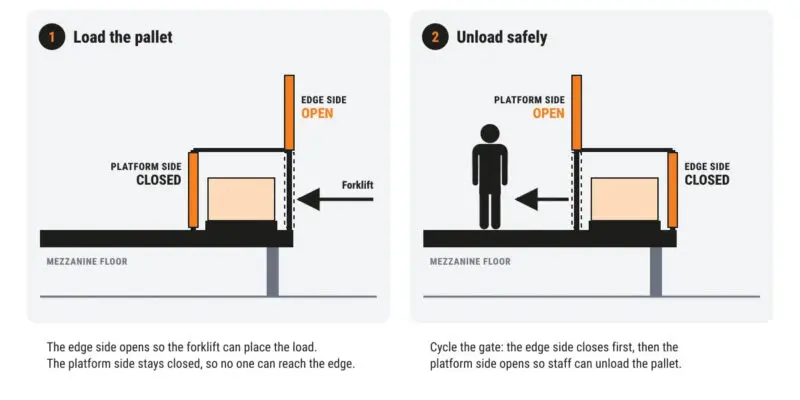
A pallet gate removes that reliance. It has two barriers linked together, one on the loading side and one on the platform side, and only one can be open at a time. The load goes in from below, the gate is cycled, and staff unload from behind a closed barrier. HSE guidance points to pallet gates as a recognised way to protect these openings.
Step 1: Measure before you choose
Most pallet gate problems start with a missed measurement, so take these before looking at any product.
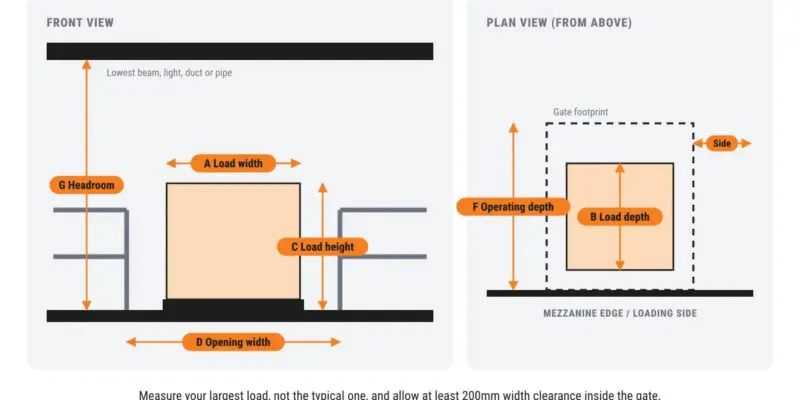
[Graphic: “where to measure” diagram marking load size, headroom, opening width, side clearance and operating depth]
- Your largest load. Width, depth and height of the biggest pallet or item you will ever lift, not the typical one. Allow at least 200mm of width clearance inside the gate.
- Headroom. The clear height above the gate position, up to the lowest beam, light fitting, duct or pipe.
- Opening width. The gap in your handrail, plus the free space either side for the gate’s side frames.
- Operating depth. How far back from the edge the gate can work without blocking walkways or racking.
- Floor type. Timber board or concrete, as this decides the fixings.
Step 2: Work out how you’ll load it
The loading method rules some gates in and others out before size even comes into it.
- Forklift: every gate works, so size and space decide.
- Crane, overhead hoist or teagle: the load comes down from above, so you need an open top. That means the Hi-Gate.
- Vacuum lifter, sack handling or pallet truck: these need a gate adapted to the method, which is what the Sigma is built for.
Step 3: Match the gate to your biggest constraint
Once you have your measurements, find the line that describes your site. The first constraint you hit is usually the one that decides.
| If your site has… | Start with | Why |
| Standard UK pallets and no special limits | Atlas | Simple tip-over gate in 1500 or 1800mm widths |
| Roof steel, lighting or services close overhead | Delta or Hi-Gate Low Headroom | Delta takes 2000mm loads within 2350mm overall height |
| Pallets or loads wider than 1800mm | Gamma | Inside widths from 2000 to 3500mm |
| Several pallets at once, or loads deeper than 1500mm | Titan | Inside depths from 2000 to 4000mm |
| A narrow walkway or small mezzanine | Omega | Compact side frames, made to measure |
| Crane, hoist or teagle loading, or very tall loads | Hi-Gate | Open top with no limit on load height |
| A doorway, roller shutter or mixed loading methods | Sigma | Fully bespoke, never projects past the edge |
If your opening doesn’t fit a standard size, the Omega, Hi-Gate and Sigma are built to your dimensions, and other gates can be modified on request.
The seven MezzBarriers gates explained
Atlas: the standard choice
The Atlas suits most mezzanines loading standard UK pallets by forklift. Its simple tip-over double barrier keeps one side closed at all times.
- Inside 1500 or 1800mm wide × 1500mm deep; 1800mm model is 2050 × 1700mm overall
- Load height 1650mm, 2150mm overall height
- 750mm-deep side frames improve pallet access
- Fixes with 8 × M12 coach bolts or anchors
View the Atlas mezzanine pallet gate
Delta: low headroom, tall loads
Choose the Delta where conventional up-and-over gates won’t clear the roof structure or services. Its dual-gate pivoting mechanism takes loads up to 2000mm high within 2350mm overall height.
[Graphic: Delta gate showing its pivoting action under a low ceiling]
- Five inside widths: 1500, 2000, 2500, 3000, 3500mm (overall = width + 250mm)
- Inside depth 1500mm, overall 1600mm
- Typical lead time 2 to 3 weeks, made to order
View the Delta low headroom pallet gate
Gamma: extra wide
The Gamma is for wide or non-standard pallets that won’t fit a standard gate. Its balanced mechanical double gate needs minimal headroom.
[Graphic: Gamma gate with a wide load in place]
- Inside widths 2000, 2500, 3000, 3500mm (overall = width + 290mm)
- Inside depth 1500mm, load clearance 1800mm, overall height 2400mm
View the Gamma extra wide pallet gate
Titan: extra large and deep
The Titan handles bulk pallet loading, multi-pallet staging and deep loads. It offers five widths and five depths for quick ordering.
- Inside widths 1500 to 3500mm; inside depths 2000 to 4000mm, both in 500mm steps
- Load clearance 1800 or 2200mm (overall height = load height + 600mm)
- Fixes with 10 × M12 bolts or anchors
View the Titan extra large pallet gate
Omega: space saving
The Omega fits where a conventional gate would take too much room: narrow walkways, restricted bays and small mezzanines. A roller-assisted pull-down, push-up action runs within compact side frames and gives access to three sides of the pallet.
- Made to measure: inside width up to 3000mm (+280mm overall), depth up to 2000mm (+100mm)
- Load height up to 2500mm (overall height = load height + approx. 1400mm)
- Replaces chains, removable bars and other temporary protection
View the Omega space saving pallet gate
Hi-Gate: unlimited load height
The Hi-Gate’s open top and scissor action let gates pivot to one side, clearing the way for cranes, hoists and suspended loads as well as forklifts. An anti-slam damper is fitted as standard.
- Custom inside width up to 2000mm (+700mm overall), depth up to 4000mm (+280mm)
- Options: asymmetric edge gate to clear adjacent handrails, teagle and hoist runway versions, doorway adaptations
- Low Headroom version for restricted clearance; approval drawings supplied for bespoke models
View the Hi-Gate universal pallet gate or the Hi-Gate Low Headroom
Sigma: bespoke multi-purpose
The Sigma solves loading problems no standard gate can, such as roller shutter openings, doorways, process platforms and vacuum lifting. Lowering the inner gate raises the outer gates through a linkage, and nothing projects beyond the platform edge.
- Inside width up to 3000mm (overall width = inside width + 800mm), depth 500 to 4000mm
- Load height up to 2250mm
- For hoist loading, extended side frames let the inner gate fold behind the landed load
- Fixes with 8 × M12 bolts or anchors
View the Sigma bespoke pallet gate
Step 4: Pick a finish and extras
Most gates come in two finishes, and the choice is mainly about environment and visibility.
- Galvanised: hot-dip galvanised to BS EN ISO 1461 for maximum corrosion resistance. The better choice for covered or sheltered outdoor platforms.
- Safety yellow: thermoplastic-coated gate tubes on a galvanised frame. The loading point stands out on a busy floor, and the coating is more comfortable to handle.
[Graphic: galvanised and safety yellow gates side by side]
Whichever you choose, every gate has a 1100mm handrail, a 100mm aluminium kick plate and bolt-together construction with no welding, so damaged parts can be swapped individually. Useful extras include an aluminium chequer floor plate for timber decks, hi-vis hazard sleeves, edge netting and extra handrailing to finish the platform edge.
Common questions when choosing a pallet gate
How long does a pallet gate take to arrive?
Most MezzBarriers gates are made to order. The Delta has a typical lead time of two to three weeks; for other models, we confirm the lead time with your quote.
Can I fit a pallet gate on a timber mezzanine floor?
Yes. Gates fix with M12 coach bolts through 38mm board floors, or M12 anchors into concrete. On timber decks we recommend adding an aluminium chequer floor plate to protect the boards at the loading point.
Will the gate fit alongside my existing handrail?
Usually, yes. The Hi-Gate can be ordered with an asymmetric edge gate that clears an adjacent handrail, and we can supply extra handrailing to close any gaps either side of the gate.
Does the gate stick out past the mezzanine edge?
The Hi-Gate and Sigma stay within their footprint and never project beyond the platform edge, which reduces the risk of a forklift or incoming load striking them. Check the overall depth of other models against your available space.
What checks does a pallet gate need once it’s installed?
Inspect pivots, tube clamps, fixings, kick plates and any rollers, wires or dampers regularly for wear or damage. Inspection should be carried out by a competent person, and a damaged gate should be taken out of use until it’s repaired.
Your site survey checklist
Take this list on site, then send us the answers for a quote.
- Largest load: width × depth × height (mm)
- Headroom above the gate position (mm)
- Opening width and free space either side (mm)
- Operating depth available (mm)
- Loading method: forklift, hoist, crane, vacuum lifter or pallet truck
- Floor: timber board or concrete
- Finish: galvanised or safety yellow
- Extras: floor plate, hazard sleeves, netting, extra handrail
- A photo of the opening
Get the right gate first time
If you’re still unsure which gate suits your mezzanine, send us your measurements and a photo through our quote request page or call +44 (0)114 244 3456. You can also browse the full range of mezzanine safety pallet gates and handrail tubes and clamps.