
Lifting Beams & Spreader Beams
Lifting beams and spreader beams provide practical solutions for lifting and handling loads where load control, stability, lifting-point positions and available headroom need to be carefully considered. Available in a range of capacities, spans and configurations, they can be used with cranes, hoists and other suitable lifting equipment across manufacturing, engineering, construction, logistics and other industrial environments throughout the UK.
Our range includes standard and adjustable lifting beams, spreader beams and specialist lifting frames, with solutions available for different load sizes, lifting capacities and applications. Where an off-the-shelf solution isn’t suitable, we can also provide bespoke lifting beams and spreader frames designed and manufactured around the requirements of the lift.
Products
-
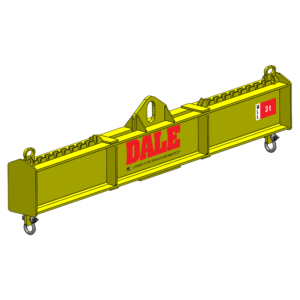
Dale Adjustable Lifting Beam Type PALR – 1t to 10t WLL (1m-6m)
Price on request -

DALE Big Bag Lifting Beam – 500kg-2t WLL
Price on request -
DALE Big Bag Lifting Beam – Bespoke Design
Price on request -
DALE DFS Fixed Length Lifting Beam – 2t-20t WLL (1.2m-6m)
Price on request -
DALE DRB Bespoke Reel Lifting Beam
Price on request -
DALE DRS Bespoke Rectangular Spreader Lifting Frame
Price on request -
DALE DTS Telescopic Lifting Beam – 2t-15t WLL
Price on request -
DALE PALF Fixed Lifting Beam – Up to 6m Span – 1t-10t WLL
Price on request -
DALE PALHR H-Bar Adjustable Low Headroom Lifting Beam – 1t-10t WLL
Price on request -
Dale PEF Fixed Lifting Beam Type – 1t-6t WLL (Up to 5m Span)
Price on request -
Dale PEM Adjustable Lifting Beam – 1t-6t WLL (1m-5m Span)
Price on request

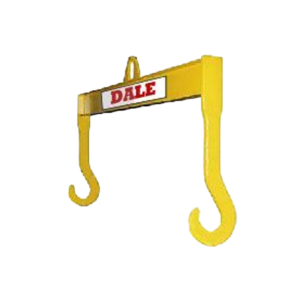
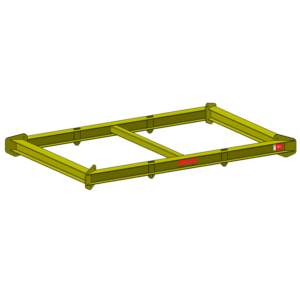
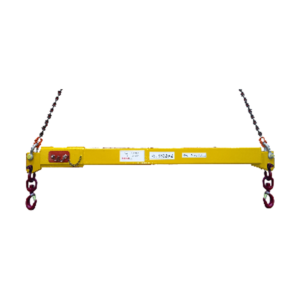
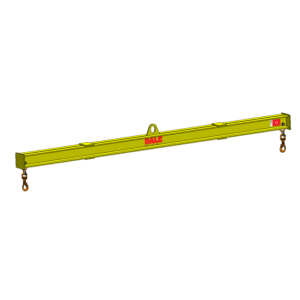
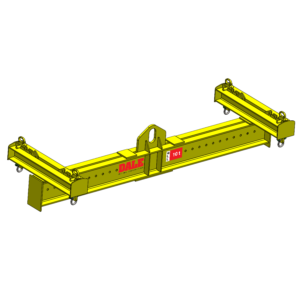
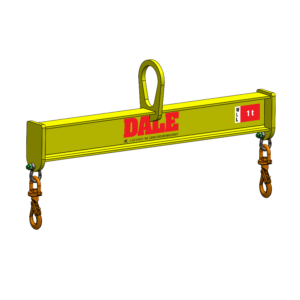
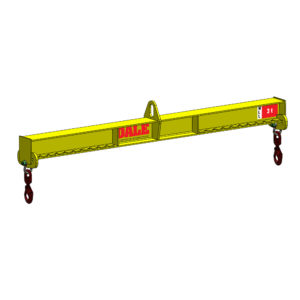
Lifting Beams vs Spreader Beams
Although lifting beams and spreader beams are both used to improve load control during lifting, they work in different ways and are suited to different applications.
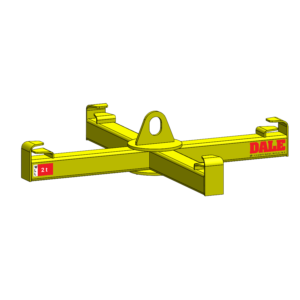
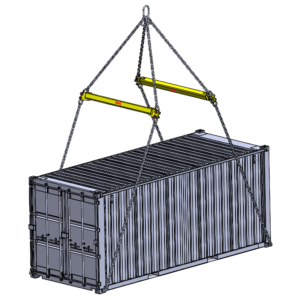
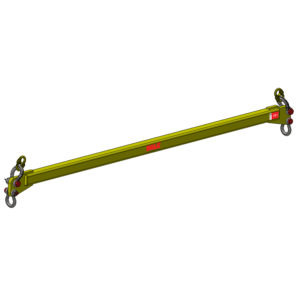
Lifting beams and spreader beams are both used to improve load control during lifting, but they perform different functions. Lifting beams are typically suspended from a central lifting point, with lifting points along the beam used to support the load below. Spreader beams use a beam or frame between the upper and lower lifting points to maintain separation and help control the geometry of the lift.
The most suitable arrangement depends on factors including the load dimensions and weight, required WLL, lifting-point positions, available headroom, span and the lifting equipment being used.
Lifting Beam
Typically suspended from a single lifting point or central connection, with lifting points positioned along the beam to support the load below. This can provide a compact lifting arrangement and can be particularly useful where available headroom is limited or where lifting points need to be positioned at specific locations.
Spreader Beam
Uses a beam or frame between the upper and lower lifting points to distribute the lifting forces and maintain separation between the lower lifting points. This can help control sling angles, reduce inward forces on the load and provide greater stability when lifting wide or awkward loads.
The most suitable solution depends on factors including the load weight and dimensions, required Working Load Limit (WLL), lifting-point positions, available headroom, span, centre of gravity and the type of crane or hoist being used.
Types of Lifting Beams and Spreader Beams
Our range includes different beam and frame configurations to suit a variety of lifting applications.
- Lifting beams for controlled lifting where multiple lifting points are required below a central lifting connection
- Adjustable lifting beams where lifting points or the effective span need to be changed to suit different loads
- Telescopic lifting beams for applications requiring an adjustable beam span
- Low-headroom lifting beams where available lifting height is restricted
- Spreader beams for lifting wider loads and maintaining separation between lower lifting points
- Spreader frames for applications requiring multiple lifting points or a larger support area
- Specialist lifting beams and frames designed around particular loads or lifting arrangements
- Bespoke lifting beams and spreader frames for applications that cannot be accommodated by a standard design
The correct configuration should always be selected according to the load, lifting arrangement, WLL and manufacturer’s requirements.
Choosing the Right Lifting Beam
Selecting a lifting beam or spreader beam involves more than simply matching the beam capacity to the weight of the load. The complete lifting arrangement needs to be considered to ensure the beam, lifting equipment, slings, connections and load are suitable for the intended lift.
Key considerations include:
- Load weight and WLL – the beam must have a suitable Working Load Limit for the intended load and lifting arrangement
- Beam span – the required distance between lifting points can affect the type and size of beam required
- Lifting-point positions – fixed or adjustable lifting points can be selected depending on the load and application
- Available headroom – a low-headroom lifting beam may be preferable where vertical space is restricted
- Load dimensions – wide, long or irregular loads may require a spreader beam or frame
- Centre of gravity – lifting points need to be positioned appropriately to maintain load stability
- Sling angles – the lifting arrangement and sling angles affect the forces acting on the beam and load
- Crane or hoist capacity – the supporting lifting equipment must also have sufficient capacity for the complete lifting arrangement
For more complex applications, a bespoke beam or spreader frame may provide a more suitable solution than adapting a standard product.
Adjustable and Telescopic Lifting Beams
Adjustable and telescopic lifting beams provide greater flexibility where the same lifting equipment may be used with loads of different sizes or where lifting-point positions need to be changed.
By allowing the lifting points or beam span to be adjusted, these systems can provide a more flexible solution than a fixed beam. This can be particularly useful in manufacturing, engineering, maintenance and handling applications where load dimensions vary between lifts.
The adjustment range, lifting-point configuration and WLL should always be considered together when selecting an adjustable lifting beam.
Spreader Beams and Lifting Frames
Spreader beams and lifting frames can be particularly useful when lifting wide, long or awkward loads where maintaining the position of the lifting points is important.
A suitable spreader arrangement can help maintain separation between the lifting points and control the geometry of the lift, while helping to manage the forces acting on the load. Spreader frames can also provide multiple lifting points for specialist applications where a conventional beam arrangement may not be suitable.
Applications can include lifting fabricated steelwork, machinery, structural components, containers and other large or irregular loads.
Bespoke Lifting Beams and Spreader Frames
Not every lifting application can be covered by a standard lifting beam or spreader beam. Where the required capacity, span, lifting points, dimensions or available headroom fall outside a standard product, a bespoke solution can be designed around the application.
Working alongside our divisional partner Dale Lifting and Handling Specialists, we can provide bespoke lifting solutions from initial requirements and design through to manufacture, testing and installation where required.
Bespoke lifting beams and spreader frames can be designed around requirements such as:
- Required Working Load Limit (WLL)
- Unusual load dimensions
- Fixed or adjustable lifting points
- Restricted headroom
- Extended or compact beam spans
- Specialist lifting points or end connections
- Particular crane or hoist arrangements
- Repetitive lifting applications
- Specialist loads such as reels, machinery, fabricated structures or other difficult-to-handle items
This allows the lifting equipment to be designed around the way the load actually needs to be lifted, rather than requiring the application to be adapted to a standard beam.
Lifting Beam Components and Connections
The beam itself is only one part of a complete lifting arrangement. The connection between the beam, lifting equipment, slings and load needs to be suitable for the intended application and compatible with the beam’s design and WLL.
Depending on the beam or spreader configuration, components may include:
- Lifting lugs and pad eyes
- Shackles and connecting hardware
- Master links and sling assemblies
- Adjustable lifting points
- Hooks and lower connection points
- Chain or wire rope slings
- Beam end fittings and connection points
All components used with a lifting beam or spreader beam should be selected according to their rated capacity and compatibility with the complete lifting arrangement.
Lifting Beams for Specialist Applications
Different loads and lifting environments can require different beam configurations. Alongside general-purpose lifting beams and spreader beams, our range includes specialist solutions for applications such as machinery handling, fabricated steelwork, reels, containers and bulk bags.
Where a standard product doesn’t provide the required combination of capacity, span or lifting-point arrangement, our bespoke design and manufacturing service can provide a solution tailored to the application.
Testing, Certification and Inspection
Lifting beams and spreader beams are lifting accessories and should be appropriately designed, manufactured, tested and maintained for their intended use.
Each lifting beam should have suitable identification and information showing its Working Load Limit and other relevant details. Inspection and thorough examination are also important to identify damage, deformation, corrosion, wear or other conditions that could affect the equipment.
Lifting equipment must also be examined at appropriate intervals under the relevant LOLER requirements, depending on the equipment and application.
Need Help Choosing a Lifting Beam?
If you’re unsure whether a lifting beam, adjustable beam, spreader beam or bespoke lifting frame is right for your application, our team can help.
Tell us the load weight, dimensions, lifting points, required span and available headroom, along with any other requirements you have, and we can help identify a suitable lifting solution.